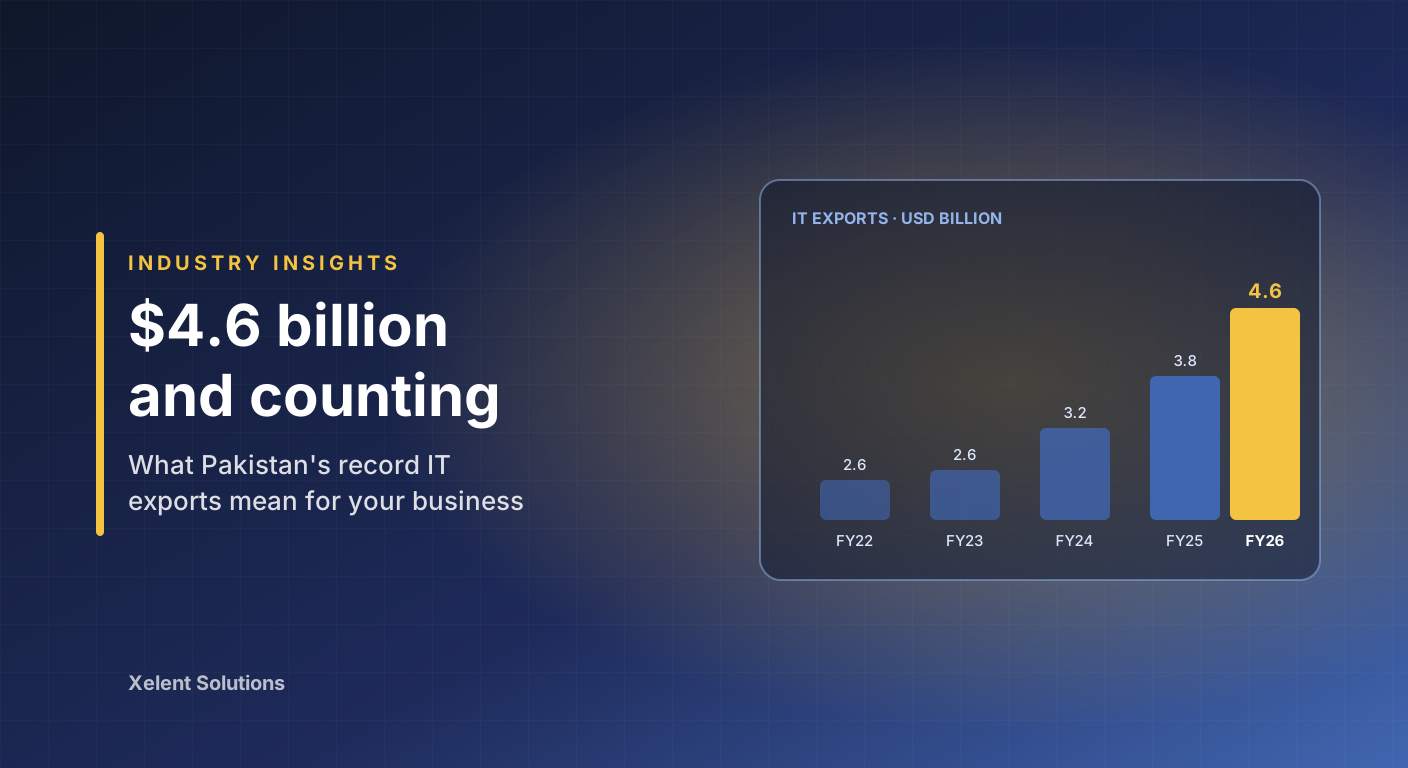
Pakistan's technology industry closed the last financial year with a number worth pausing on. IT and IT-enabled services exports for FY2025-26 reached a record $4.6 billion, up 20% from $3.814 billion the year before, an increase of $786 million in a single year, according to figures reported by ProPakistani and Arab News.
The government's target had been $5 billion, so the year fell short of the headline goal. But a 20% rise on a base of nearly $4 billion is not a rounding error. It is the result of a lot of companies, in a lot of cities, winning and keeping foreign clients through a difficult macroeconomic period. For anyone running a business in Pakistan, whether you sell software or buy it, that is worth understanding.
What drove the growth
Reporting on the figures pointed to a few consistent drivers: regulatory reforms, foreign-currency retention facilities that let exporters hold part of their earnings in dollar accounts, a favourable tax regime for the sector, and, more plainly, the resilience of the industry itself (ProPakistani, Arab News).
The momentum was visible well before the year closed. September 2025 was a record month at the time, with $366 million in exports, up 25% year on year, and the first quarter of FY26 came in at $1.06 billion, up 21%, according to Topline Securities figures reported by Nukta. The full-year result confirmed that those early months were a trend rather than a spike.
The policy side matters here. Tax certainty is one of the few things a government can give an export industry that costs little and changes behaviour a lot. The FY27 budget extended the preferential tax regime for IT companies and freelancers by a further three years (ProPakistani). For a software house deciding whether to hire ten more engineers or open a second office, knowing the tax treatment for the next three years is the difference between planning and guessing.
What the industry itself said
The Pakistan Software Houses Association, P@SHA, welcomed the result while being clear about what comes next. Its Senior Vice Chairman, Muhammad Umair Nizam, called it plainly: "Crossing the US$ 4.6 billion mark in IT exports is a significant milestone for Pakistan." He also said that sustaining the momentum would require "policy consistency, ease of doing business, investment in digital skills" (ProPakistani, Arab News).
That is the right framing. The record is real, and it was earned. It is also not guaranteed to repeat without the conditions that produced it.
The honest constraints
Any optimistic piece on this industry has to name the two problems every software house in the country deals with daily, and the same reporting did: slow internet and power outages (ProPakistani, Arab News).
What do those mean in practice? They mean the $4.6 billion was achieved by companies that have had to build their own resilience. Backup power is a line item, not an afterthought. Teams keep secondary connections. Client calls are planned around known risks. Every software house of any size in Pakistan has engineered around infrastructure that its competitors in other countries take for granted.
There are two ways to read that. One is that the industry is held back, which is true, and that reliable power and connectivity would unlock growth beyond what the current numbers show. The other is that the companies posting these results have already proven they can deliver to international standards under conditions that would stop many others. Both readings are correct, and the second one is the more useful if you are deciding whether to trust a Pakistani software company with your project.
What this means if you are a Pakistani business buying software
This is the part that gets less attention than the export headline deserves.
The engineering capability that earned $4.6 billion from foreign clients does not switch off when the client is local. The same teams that build and maintain products for companies in the UK, the US and the Middle East are increasingly serving domestic firms: manufacturers, distributors, hospitals, retailers, schools and service businesses that need real systems rather than spreadsheets.
For a Pakistani business, that changes the calculation. A few years ago, buying serious software locally often meant choosing between an expensive foreign product that did not understand local tax rules or payroll, and a cheap local product that was not maintained. Today a maturing industry offers a third option: export-grade engineering, built by people who understand FBR and PRA requirements, Urdu-speaking staff, local banks and the way business is actually done here, at prices set for the local market.
The export record is, in effect, a quality signal for domestic buyers. An industry that can keep international clients for years can certainly build and support your ERP, your invoicing system or your website.
What it means for software houses outside the big three cities
The industry narrative is usually told from Karachi, Lahore and Islamabad, and those cities account for most of the headcount. But the growth is not confined to them, and there is a structural reason to expect that to continue.
A software house in Faisalabad, Multan, Peshawar or Sialkot sells the same skills to the same foreign clients as a firm in Lahore. Its costs are lower. Its staff are more likely to stay, because they are not competing with a hundred other employers on the same street. And it sits next to industrial economies, textiles in Faisalabad, sports goods and surgical instruments in Sialkot, that need software and have historically been underserved by it.
The remaining gap is the one P@SHA named: digital skills, and the ecosystem of universities, training and mentorship that produces them. That is where cities beyond the big three have the most to gain from the three-year policy window.
Xelent's view
Xelent Solutions has been a PSEB-registered software house in Faisalabad since 2013. We have spent those years doing exactly what the export figures describe: building and supporting software for clients in Pakistan, the UK, the US and the Middle East, from a city that is better known for textiles than for technology. Products like our Textile ERP, FBR Digital Invoice, TrangoHub, Craftlio, carDMS, Ledgerly, Payrolio and HMS exist because the problems we solved for one client turned out to be shared by many.
We read this year's record the way P@SHA does: as a milestone earned under difficult conditions, and as a reason to keep investing, not a reason to relax. For the businesses we serve in Pakistan, the message is simpler. The engineering that the rest of the world is buying from this country is available to you too, from people who understand your market.
If you would like to know more about who we are, visit About Us. If you have a project or a problem you would like to talk through, contact us.