Until recently, "digital invoicing" in Pakistan was something only large manufacturers and importers worried about. That is no longer true. Over the past year the Federal Board of Revenue (FBR) has extended its digital invoicing regime to businesses of every size, and the Punjab Revenue Authority (PRA) has banned handwritten receipts across restaurants, hotels, marriage halls and other service businesses in the province.
If you run a sales-tax-registered business, or a service business in Punjab, the question is no longer whether you need compliant invoicing software. It is which one, and how quickly you can be live on it.
This guide explains both regimes in plain language, what they mean together, and what to look for in a solution.
What FBR digital invoicing actually is
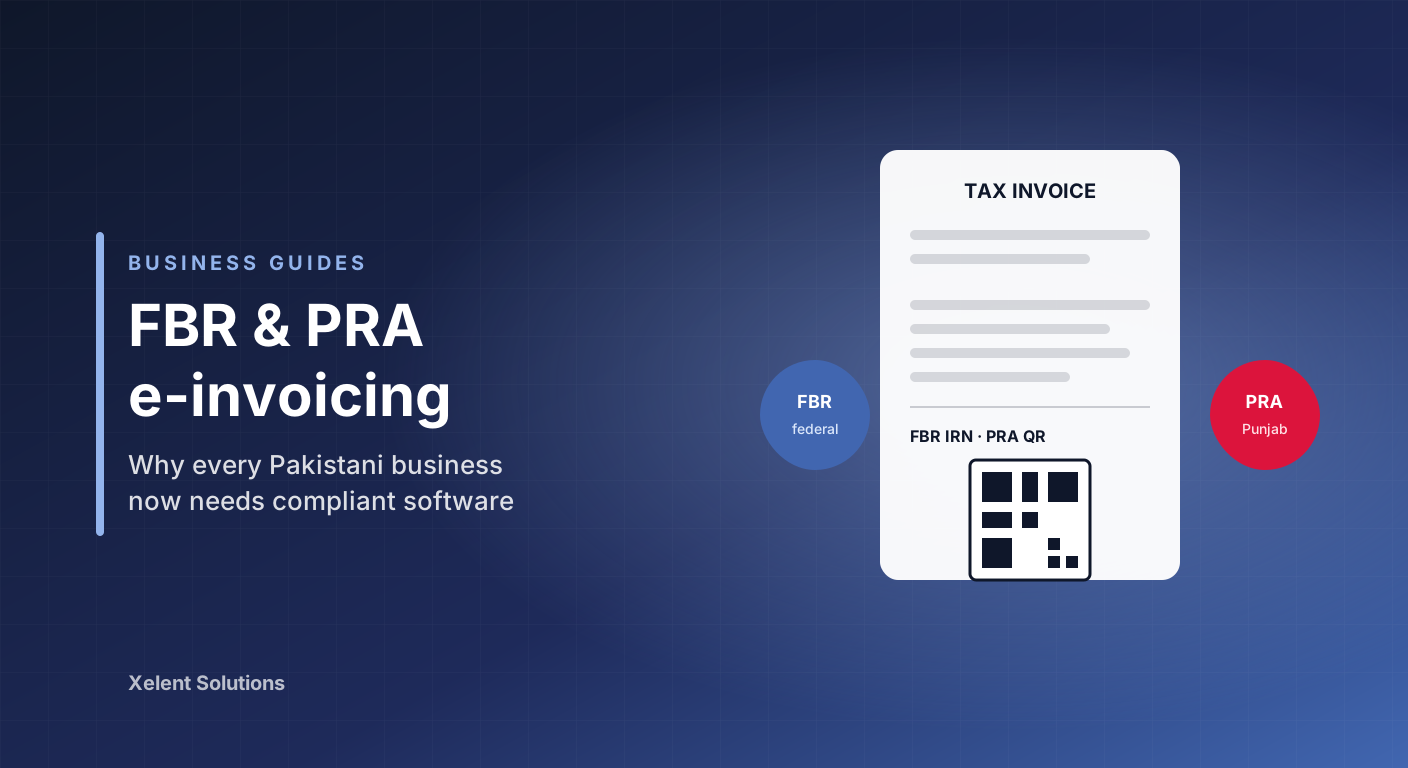
FBR's digital invoicing regime requires sales-tax-registered persons to issue invoices through a system that is connected to FBR in real time, via a licensed integrator. Each invoice is reported to FBR at the moment it is issued and carries an FBR reference and QR code. The legal basis is SRO 1413(I)/2025 of 1 August 2025, which obliges registered persons to integrate through a licensed integrator and issue digital invoices.
Who is covered, and when
The rollout has been phased by turnover, building on SRO 1852(I)/2025. According to a summary of the July 2026 deadline, the sequence was:
- First: public companies, importers, and businesses with turnover above Rs 1 billion.
- Second: businesses with turnover between Rs 100 million and Rs 1 billion.
- Third: businesses with turnover below Rs 100 million.
- Finally: all remaining categories, within the July 2026 window.
In practical terms, if you are registered for sales tax, you are now in scope. The turnover bands only determined the order, not whether you would eventually be included.
Licensed integrators and the 72-hour rule
In April 2026 FBR issued Sales Tax General Order 01 of 2026, which clarified two operational points that matter day to day:
- A registered person may engage one or more licensed integrators. You are not locked into a single provider.
- An invoice that has already been reported can be cancelled or edited only for a bona fide mistake within 72 hours. After that window, changes need the Commissioner's approval.
That second point changes how your front desk works. A wrong quantity or price is no longer corrected quietly in a ledger at month end. It has to be caught and corrected within three days, through the system, or escalated formally.
Notified service businesses: "no supply except through connected systems"
In February 2026 FBR went a step further. SRO 288(I)/2026 directed e-invoicing integration with the income-tax system for a specific list of businesses:
- Restaurants, hostels, motels, guest houses, marriage halls, marquees and clubs
- Inter-city transport, courier and cargo services
- Beauty parlours and clinics
- Medical practitioners, dentists, physiotherapists, veterinarians and pathology labs
The wording is strict: integrated enterprises may make supplies only through systems connected to FBR's network. For these businesses, an unconnected till or a paper invoice book is not a fallback. It is a breach.
What PRA's EIMS mandate adds in Punjab
Punjab collects sales tax on services separately, through the Punjab Revenue Authority. In August 2026 PRA imposed a province-wide ban on handwritten receipts for hotels, restaurants, coffee shops, marriage halls and other service businesses.
Under the mandate:
- Every receipt must be generated through PRA's Electronic Invoice Monitoring System (EIMS).
- The receipt must show the business name, address, receipt number and the PRA QR code.
- Kitchen order slips and unpaid bills cannot be handed to customers as receipts.
- Fines range from Rs 400,000 to Rs 1 million, and repeat violators can be sealed for up to one month.
For a restaurant or banquet hall in Lahore, Faisalabad or Multan, this means the bill a waiter brings to the table is itself a regulated document. If it did not come out of an EIMS-connected system with a QR code, the business is exposed.
Why the two together make compliant software non-negotiable
Either mandate on its own would justify replacing paper invoices. Together, they close every gap.
The penalties are severe and repeat. Under the Sales Tax Act 1990, non-compliance with FBR digital invoicing starts at roughly Rs 500,000 per instance and escalates to Rs 3,000,000 for repeat violations, with penal proceedings under Section 33. Add PRA's Rs 400,000 to Rs 1 million per violation and the sealing power, and a single bad month at a mid-sized restaurant can cost more than a year of software.
Your invalid invoice becomes your customer's problem. Invoices issued outside the FBR system are treated as invalid, which affects the buyer's input-tax adjustment. B2B customers who understand this will stop buying from suppliers who cannot issue a valid digital invoice. Compliance is becoming a condition of doing business, not just a tax matter.
Many businesses sit under both authorities. A hotel with a restaurant, a marriage hall that supplies catering, a clinic that sells products: these are exactly the categories named in both SRO 288(I)/2026 and the PRA mandate. Running two unconnected systems, or one system that only talks to one authority, doubles the chance of error.
Corrections are now time-boxed. The 72-hour edit window means your invoicing process has to be right the first time, and your staff need a system that makes corrections visible and traceable.
What to look for in a compliant solution
Not every product that says "FBR ready" will serve you well. When you evaluate options, check for the following.
- Real-time reporting to both FBR and PRA, with the correct QR code and reference printed on every invoice and receipt, so that one transaction satisfies both authorities where both apply.
- A clear path for your existing data. If you already run a POS or ERP you do not want to abandon, you need a reliable way to move invoices into the compliant system. Be realistic: a well-defined CSV import is more dependable than a promised "plug-in" that depends on your old system's internals.
- Correction and cancellation workflow that respects the 72-hour rule and records who changed what.
- Role-based access, so that cashiers can issue invoices but cannot alter reported ones.
- Industry fit. A marriage hall needs event booking and menu-based billing; a hotel needs room folios; a retailer needs barcode and stock. Fiscal compliance should sit inside the software you actually run the business on.
- Local support that understands the regulations, because the rules have changed four times in twelve months and will change again.
How Xelent covers it
Xelent builds its FBR and PRA fiscalisation layer in-house, so we can respond when a new SRO or general order changes the rules.
- FBR Digital Invoice is our standalone software for businesses that need FBR digital invoicing only. If you want to keep your existing POS or ERP, you export your invoices to it by CSV and it handles reporting to FBR. It is not a plug-in into your current system; it sits alongside it as the compliance layer.
- FBR and PRA Compliance is for businesses that answer to both authorities, so a single workflow produces FBR-reported invoices and PRA EIMS receipts with the right QR codes.
- For businesses that would rather run everything on one fiscal-ready platform, our Xelent POS, Marquee Management and Hotel Management products have compliance built in, so your billing, bookings and stock live in the same system as your tax reporting.
A note before you act
This article is a plain-language summary, not tax advice. The turnover bands, notified categories and deadlines described here come from the SROs and orders linked above, and FBR and PRA continue to update them. Confirm which category your business falls into, and which registrations you hold, with your tax consultant before choosing a system.
Once you know your category, the software decision is straightforward. If you would like a walkthrough of how FBR Digital Invoice or the FBR and PRA compliance setup would work for your business, contact us and we will show you with your own invoice data.