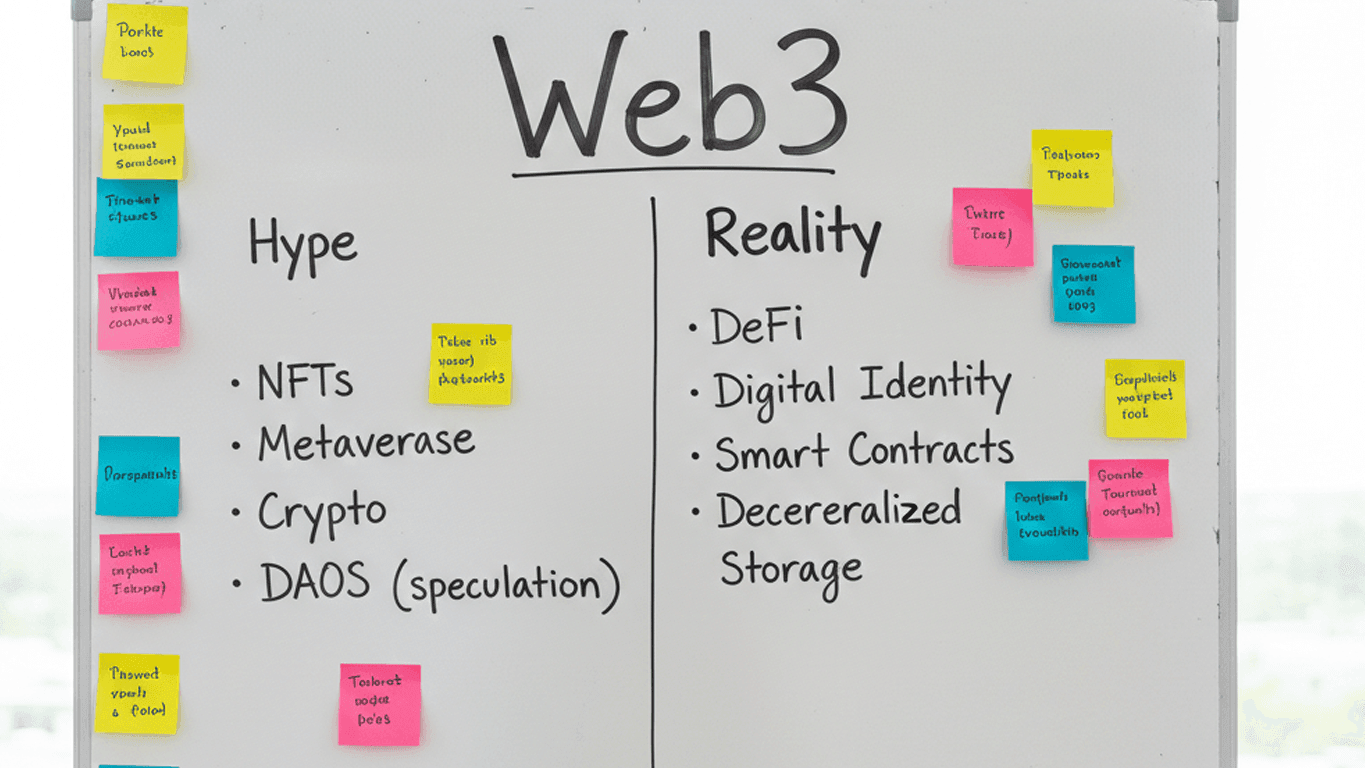
Web3 — the vision of a decentralized internet built on blockchain technology — has captured enormous attention and investment. Proponents see it as the next evolution of the internet. Critics dismiss it as speculation dressed up as innovation. The truth lies somewhere in between.
What is Web3?
Web3 envisions an internet where users own their data, applications run on decentralized networks, and intermediaries are replaced by smart contracts. The key technologies include:
- Blockchain — Distributed ledgers that record transactions without central authority
- Smart contracts — Self-executing programs that run on blockchains
- Tokens — Digital assets that can represent ownership, access, or value
- Decentralized storage — Systems like IPFS that distribute file storage across networks
Where Web3 Has Real Potential
Decentralized Finance (DeFi)
DeFi protocols have demonstrated that financial services — lending, borrowing, trading — can operate without traditional intermediaries. While still nascent, the total value locked in DeFi protocols has grown dramatically.
Digital Ownership
NFTs, despite the speculation, have established a framework for verifiable digital ownership. This has practical applications in gaming, digital art, music rights, and credential verification.
Identity and Privacy
Self-sovereign identity systems could give users control over their personal data, sharing only what is necessary for each interaction without relying on centralized identity providers.
Where the Hype Exceeds Reality
Scalability
Current blockchain networks process a fraction of the transactions that centralized systems handle. Ethereum processes roughly 15 transactions per second. Visa processes 65,000.
User Experience
Interacting with Web3 applications requires managing wallets, understanding gas fees, and navigating complex interfaces. Until the user experience matches Web2 applications, mainstream adoption remains limited.
Energy Consumption
Proof-of-work blockchains consume enormous amounts of energy. Ethereum's transition to proof-of-stake addresses this for one network, but the environmental concerns remain valid for the broader ecosystem.
Regulation
The regulatory landscape for blockchain and crypto assets is uncertain and evolving. Businesses building on Web3 technologies face significant regulatory risk.
A Pragmatic Approach
For businesses, the question is not whether Web3 is "good" or "bad" but whether specific Web3 technologies solve real problems better than alternatives.
Our recommendation: monitor the space closely, experiment with technologies that address genuine business needs, but avoid betting your business on unproven infrastructure. The most valuable Web3 innovations will be those that solve real problems — not those that simply decentralize for the sake of decentralization.